Malta should stand with Sánchez on Ceuta
Mintoff would not have looked the other way while a fellow Mediterranean country was being pressured by a larger geopolitical game

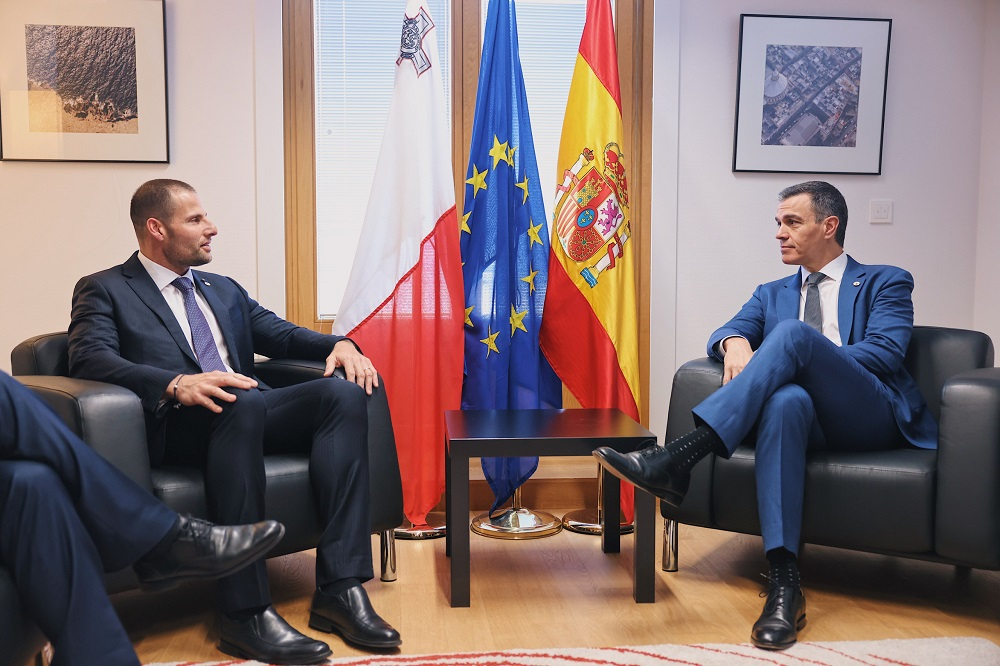

Malta has a choice to make at the EU meeting on the Ceuta crisis. Our government should stand with Pedro Sánchez because the attempt to turn a humanitarian crisis on Spain’s doorstep into a political attack on the Spanish government is dangerous for Europe.
Never in the history of the European Union has an aggrieved member state been turned into the villain of a crisis in which it is itself the target. Yet this is precisely what is happening to Spain over the events in Ceuta, where a mass influx of migrants appears to have been weaponised against the government of Pedro Sánchez — and where, instead of rallying around a fellow member state confronting what looks increasingly like an episode of hybrid warfare, parts of Europe’s political establishment have chosen to pile on.
Today, EU interior ministers are meeting to address the Ceuta migration crisis. The emergency summit, called by 22 member states, pits countries like Italy, which has blamed Spain for endangering Europe’s external borders, against Spain, which insists on shared responsibility. What is most unfortunate is that the vilification of Spain has been based on falsehoods.
Start with the most obvious falsehood: the idea that tens of thousands of people entering Ceuta suddenly gained a gateway into the rest of Europe.
They did not.
Ceuta and Melilla are subject to special Schengen rules, including identity and document checks for people travelling from the enclaves to mainland Spain or other Schengen countries. The European Commission has explicitly confirmed this. The claim that migrants reaching Ceuta could simply disperse across Europe amounts to the kind of misinformation reminiscent of the Putin regime.
Nor does Spain’s recent regularisation programme explain what happened. The scheme applies to people who were already in Spain before January 2026, with applicants required to demonstrate at least five months of continuous residence. To suggest otherwise is to manufacture a “pull factor” that simply does not exist.
Yet this misinformation has been allowed to become political ammunition.
The mass crossing was preceded by an extraordinary online mobilisation, fuelled by false claims surrounding a Spanish court ruling. More than 50,000 people entered Ceuta in a remarkably short period, while nearly all those who entered the enclave were subsequently returned to Morocco. Spanish authorities have attributed the mobilisation to misinformation and criminal networks, while questions remain over the role played by the Moroccan authorities in allowing the border to open.
The sequence of events carries the finger prints of retribution by foreign powers intent on destabilising Spain.
Spain has recently been rebuilding relations with Algeria, including deepening cooperation in energy, after Sánchez’s visit to Algiers on 20 July. Morocco, meanwhile, has a long record of using migration pressure as leverage in its disputes with Spain. The 2021 Ceuta crisis was explicitly described in the European Parliament as a case in which Morocco had eased border controls, allowing around 9,000 people to enter.
This is what makes the current episode so worrying: migration can be weaponised.
And this is where Manfred Weber and the European right should have known better. Instead of strengthening European solidarity with a member state confronting an extraordinary border emergency, the crisis has been turned into another opportunity to attack Sánchez’s migration policy. The far right was always going to exploit the images. The shame is that mainstream conservatives have joined the feeding frenzy.
Malta should not.
There is also a wider reason for Abela to stand with Sánchez.
Spain has been one of Europe’s strongest voices against Israel’s conduct in Gaza, explicitly referring to the situation as genocide and imposing measures including an arms embargo and restrictions on settlement imports. Morocco, meanwhile, joined the Abraham Accords in 2020, while the Trump administration recognised Moroccan sovereignty over Western Sahara.
None of this proves that Israel, the United States or Morocco engineered the Ceuta crisis. But one cannot deny the convergence of geopolitical interests and the possibility that existing influence networks have exploited the episode.
But Malta does not need to solve that mystery today.
Malta has recognised Palestine. It has consistently supported the two-state solution and opposed forced displacement. Spain has stood alongside countries such as Malta in advancing Palestinian statehood. On this, Malta and Spain belong together.
And perhaps there is one final lesson for a small island state: outsourcing migration control to third countries always carries a price. If a neighbouring government can open or close a border and thereby create political turmoil inside the EU, migrants become bargaining chips and the EU becomes vulnerable to blackmail.
That is not European solidarity. It is its opposite.
Malta should tell Europe today that Malta will not participate in the cannibalisation of Spain. Whatever legitimate questions exist about Ceuta must be investigated. Those responsible for exploiting migrants must be held accountable. But Spain should not be made the scapegoat.
Mintoff would not have looked the other way while a fellow Mediterranean country was being pressured by a larger geopolitical game.
Malta should not either.


-

National
MHRA president calls cannabis legislation "very big mistake"
-

Court & Police
24-year-old avoids 10 months’ jail after appeal over bail curfew breach
-

Court & Police
Courts drops domestic violence charges at couple’s request
More in News-
.png)
Business News
GO questions impact on competition after Melita's announced takeover of Epic
-

Business News
Salvo Grima Group appoints David Valenzia to its Board of Directors
-

Business News
Izola Bank set to get new French shareholder
More in Business-

Other Sports
Micallef signs off GB3 in style at Donington Park
-

Other Sports
Giacomo Camilleri joins Spanish club BC Badajoz
-

Other Sports
Graham Borg claims fifth FiTri Masters 2 victory of the season
More in Sports-

Cultural Diary
My essentials: Scott Le Crass’s cultural picks
-

Art
Spazju Kreattiv launches the new programme for 2026/27
-

Theatre & Dance
ARTi returns in Maltese as part of Teatru Manoel’s new season
More in Arts-

Opinions
Why does it seem like the world is becoming more uncertain?
-

Opinions
Malta: A country of sacrifice zones
-

Opinions
Election mode has not switched off
More in Comment-

Restaurants
Tapea: Where Spain comes alive in St Julian's
-

Articles
Premju Emanuele Luigi Galizia returns to celebrate Malta’s best in architecture
-

Restaurants
MasterChef Thailand’s Ian Kittichai brings his famous take on Thai cuisine to Valletta
More in Magazines