


.jpg)


.jpeg)


WATCH | Mario de Marco: ‘Tourism needs consistency, not shock treatment’
Mario de Marco argues a reduced VAT rate for catering establishments would boost sustainability, competitiveness and transparency, even if prices may not fall. The Nationalist Party’s tourism spokesperson talks to Nicole Meilak

29 March 2026, 6:15am
Nicole Meilak
Nicole Meilak
6 min read

Nationalist Party’s tourism spokesperson Mario de Marco (Photo: James Bianchi/MaltaToday)

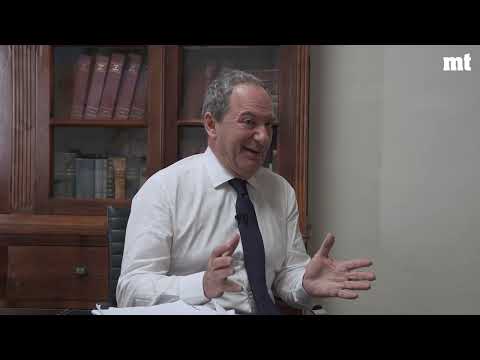
The Nationalist Party’s proposal to lower VAT for restaurants is intended so that they can enjoy the same rate currently charged at hotels, Mario de Marco explains.
The PN’s tourism spokesperson lays out the case for the proposal by pointing to an inconsistency in the current system—food served in hotels is subject to a 7% VAT rate, while the same meal eaten in a standalone restaurant carries an 18% charge. Meanwhile, ready-to-eat food sold in supermarkets is charged at zero per cent.
“So, right now you have this distinction between 18% for restaurants, 7% for food from hotels, and zero for food already cooked from supermarkets,” he tells me. “This is creating a bit of an unlevel playing field.”
De Marco says the proposal did not originate with the PN but has been pushed by industry bodies including the Association of Catering Establishments for a long time. It is also mentioned in documents recently published by the Malta Chamber of Commerce.
He also points to Malta’s competitive disadvantage relative to Mediterranean rivals such as Greece, where restaurant VAT is set below the standard rate.
On whether a VAT cut would actually translate into lower prices for consumers, De Marco acknowledged the scepticism. “I hope that where the saving is not passed on to the consumer, it will at least make the operation of that restaurant more sustainable, which means more profit, which means more income tax paid to government.”
He said the measure would be partly self-financing, with any reduction in VAT revenue offset by increased income tax receipts from more viable businesses.
De Marco also links the VAT proposal to improved compliance. He recalled that Finance Minister Clyde Caruana had previously claimed the average restaurant pays only around €4,500 in annual tax. De Marco says this suggests that many operations are barely viable or that the revenue authority’s grip on declared income is still weak. A lower VAT rate paired with an efficient charging system would bring greater oversight of what restaurants actually collect.
Beyond VAT, De Marco speaks about a range of broader challenges facing Maltese tourism. He argues that Malta, with a tourist-to-resident ratio that is among the highest in the world, urgently needs to shift its focus toward quality over quantity.
He raises concerns about declining average length of stay, financial leakage through foreign airlines and remittances sent abroad by foreign hospitality workers, and the growing impact of short-let platforms like Airbnb on residential communities, particularly in Valletta and St Julian’s.
Asked what a PN government would prioritise in its first 100 days, De Marco said the immediate task would be to bring all stakeholders around the table, including local communities, not just industry investors. “Tourism does not need shock treatment,” he insists. “What it needs is consistency in direction.”
The following is an abridged transcript of the interview
The PN is proposing to lower VAT for restaurants to 7%. Finance Minister Clyde Caruana has said the measure could cost around €100 million. Has the PN done its own costing?
This is not only a PN idea. If you look at the pre-budget documents submitted by the Association of Catering Establishments over the past two years, and the Chamber of Commerce document just published, this proposal is there. The reason is simple. Right now, hotels charge 7% VAT on food they serve to guests. Restaurants charge 18%. And supermarkets selling ready-to-eat food charge zero. So, for the same service you are paying 18% outside the hotel and 7% inside. That is an unlevel playing field. There is also the fact that in a number of Mediterranean countries the VAT rate for restaurants is lower than the standard rate.
But will prices actually go down? I have rarely seen a scenario where they do.
That is a valid point. There is the possibility that prices are lowered, but in operations that are already established and stable, if the saving is not passed on to the consumer, I hope it will at least make that restaurant more sustainable. If it becomes more sustainable it will make more profit. If it makes more profit, it will pay more income tax. So, if the government collects less in VAT, it will collect more in income tax. We have to see this from two tracks and I hope they balance out for the consumer, for the operator, and for the government.
What exactly is a ‘quality tourist’ for the PN?
A quality tourist is one who leaves more in the Maltese economy while having less impact on the environment and infrastructure. We want to do more with less. Malta is one of the countries most impacted by tourism in the world because of our size. Our land area has not grown, but our population has risen from around 450,000 to almost 600,000, and tourist numbers have gone from 2.7 million to four million. The tourist-to-resident ratio we have is among the highest anywhere in the world. The impact is felt everywhere—in sewage systems that could not cope in certain summers, in energy blackouts during peak season, in rubbish left on streets. We need to balance what tourism is costing us against what it is actually leaving behind.
What about Airbnb and short lets?
Airbnb is a reality and we cannot avoid it. Close to 40% of tourists are now staying in private accommodation rather than hotels. The problem is this phenomenon spreads the negative impacts of tourism. When you have a hotel, one hotelier is responsible for waste, behaviour and order. When you have 600 tourists spread across 200 apartments in a residential block, you have noise problems, waste collection problems, neighbours being inconvenienced. The government closed a public consultation on new rules last December, yet here we are at the end of March about to enter another summer with no regulation in place. We need to go beyond pilot projects. There is also the impact on housing. Apartment owners in Valletta are choosing to rent to tourists rather than to young Maltese families, reducing the supply of affordable residential accommodation in the city.
If you were tourism minister in a PN government’s first 100 days, what would you do?
The first thing is to get everyone around the table. And I mean everyone, not only those who are investing in tourism. The communities need to be there too. Tourism does not need shock treatment. We cannot stop flights overnight, cap tourist numbers, or halt development. That would be the worst thing we could do. What tourism needs is consistency in direction. The Vision 2050 document is a start but the government cannot expect that, in such an important sector, everything rests on a handful of initiatives. We need a real, shared vision of where we want to get to and how, and we need to hit the ground running to deliver it.

Nicole Meilak was deputy online editor at MaltaToday. She won the Most Promising Journalis...