


.jpg)


.jpeg)


Malta and Palestine: The small country that stopped standing tall
Long read | Once willing to punch above its weight on the Palestinian cause, Malta now appears increasingly reluctant to lead. James Debono catches up with former Foreign Minister Evarist Bartolo and former journalist and human rights activist Karl Schembri to ask why

30 August 2026, 6:15am
James Debono
James Debono
17 min read


Once upon a time, Malta had statesmen like Dom Mintoff and Guido de Marco at the forefront of advocacy for Palestinian self-determination. They used international fora like the United Nations or the non-aligned movement to push what had become a core tenant of Malta’s foreign policy.
Ironically, now that Malta sits at the same table of bigger and influential European nations, it seems to have lost its yearning to lead. Instead, Malta is keener to follow other countries even if it has not abandoned the Palestinian cause.
But former Foreign Minister Evarist Bartolo believes the deeper change is one of “political dignity”. It is a sentiment shared by Karl Schembri, a former journalist and human rights activist, who has documented history from Gaza itself.

Former Foreign Minister Evarist Bartolo
Malta, they argue, has progressively lost the backbone to stand up for what it believes in when doing so risks angering more powerful countries or economic interests.
For Bartolo, the return of American President Donald Trump to the White House has made that loss of independence particularly visible. He believes pressure on Malta from the US and pro-Israel interests has increased considerably since Trump’s re-election.
Bartolo puts the issue in stark terms. “My impression is that upon Trump’s return to office some decision was taken in Malta to obey the USA,” he says. “We are increasingly acting like we are a US colony and our foreign policy is losing on substance.”
He bluntly describes the influence of pro-Israel interests in Washington: “The Zionist lobby controls the White House.”
Ironically, he adds, this is happening as US public opinion shifts against Israeli Prime Minister Benjamin Netanyahu’s policies.
From possible leader to follower
Malta did recognise the State of Palestine in September 2025. It also continues to support a two-state solution in the Middle East and Foreign Minister Chris Fearne says Malta is among the EU countries pushing for collective action against Israel over settlement expansion in the West Bank.
But Malta’s recognition of Palestine illustrates the changing dynamic in its foreign policy.
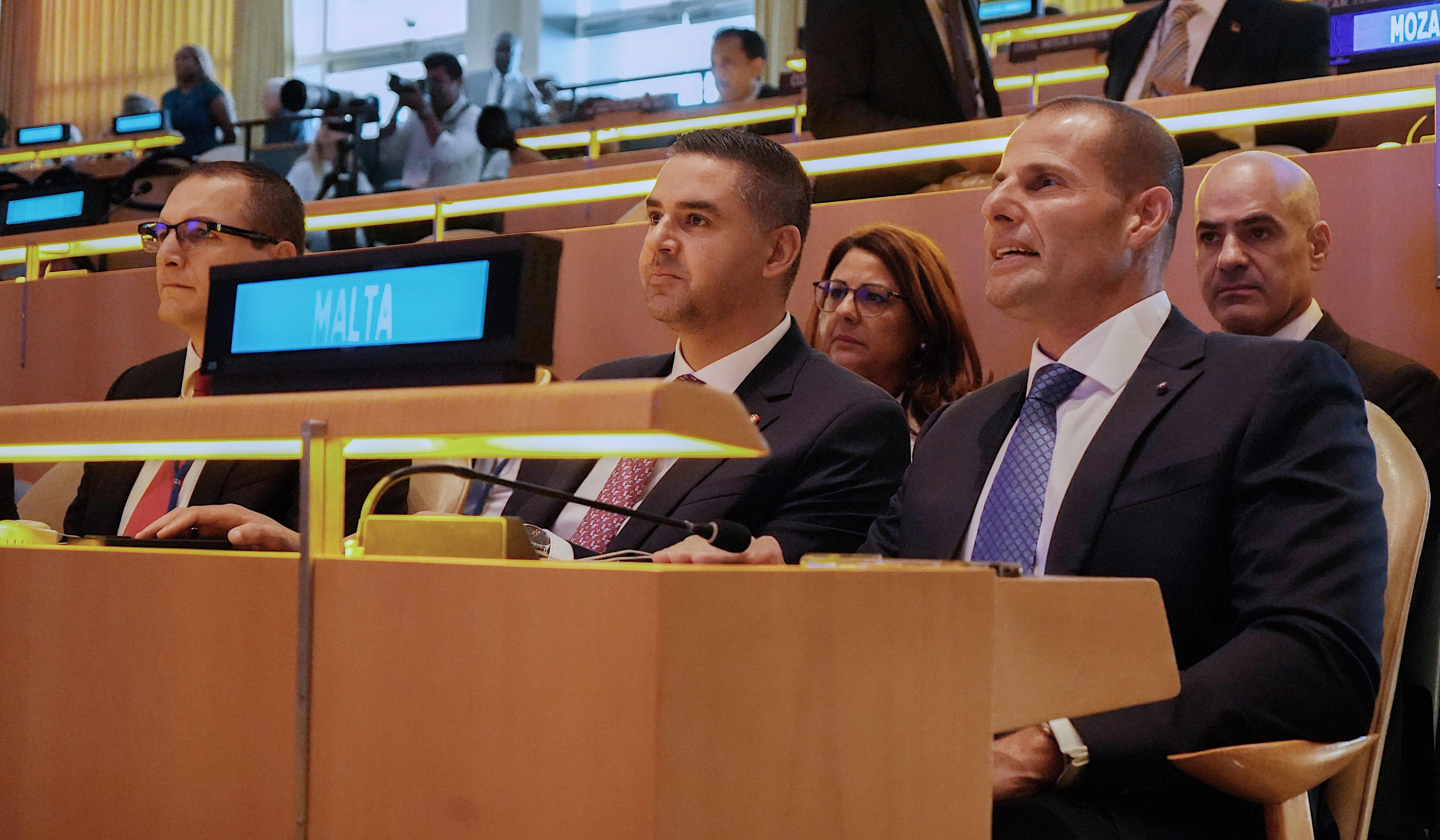
Prime Minister Robert Abela and then Foreign Minister Ian Borg at the UN General Assembly in September 2025 when Malta formally recognised the State of Palestine (Photo: OPM)
In March 2024, Malta joined Ireland, Slovenia and Spain in declaring its readiness to recognise Palestine when circumstances were right. It was a bold move. Nonetheless, when Ireland, Spain and Norway formally announced recognition of the State of Palestine in May 2024, Malta was absent. Slovenia recognised Palestine a month later.
Instead, Malta waited until September 2025, when Prime Minister Robert Abela formally announced recognition of Palestine at the United Nations General Assembly alongside a much wider group of countries, including France and the United Kingdom.
The decision was significant and consistent with Malta’s longstanding position. But the chronology also showed that Malta was no longer leading the European recognition drive.
Despite being part of the initial initiative, Malta waited while other European states acted.
For Karl Schembri, this is symptomatic of a broader loss of ambition.

Former journalist and aid worker Karl Schembri
“It is undeniable that over the past years there was a change in our attitude, which sharply contrasts with our policies when we had politicians like Dom Mintoff and Guido de Marco,” he says. “I am not romanticising that era but one has to say that Malta has lost the national ambition to make a difference and stand up for something in the world.”
It was an era that gave Malta stature, Schembri says. “Standing up for something which counts… that vision and ambition is not just a moral stance, it was a vision and ambition which gave us stature.”
When Malta stood tall
Under Dom Mintoff, support for the Palestinians became a defining feature of Maltese foreign policy.
Mintoff’s language could be extraordinarily confrontational. During a 1973 meeting of the Socialist International in London, Mintoff had told Israeli Prime Minister Golda Meir that if he had been Palestinian, he would have been a terrorist.

Prime Minister Dom Mintoff and Israeli Prime Minister Golda Meir (left) during a meeting of the Socialist International in London in November 1973
That language is difficult to transpose into today’s political environment. But it demonstrated a willingness to absorb diplomatic costs in order to make a political point.
And this was not exclusively a Labour Party position.
Guido de Marco, a leading Nationalist politician and later President of the UN General Assembly, also maintained a strong commitment to Palestinian rights.
Schembri notes that de Marco gave a distinctive touch to his own party as a rare example of a European conservative party that unashamedly supported the anti-colonial struggle in Palestine.
In 1990, as UN General Assembly president, de Marco faced Israeli opposition when he sought to visit the occupied territories. Israel initially refused entry to his delegation. De Marco did not back down, warning that the refusal could cause an international crisis, and eventually made the visit amid diplomatic friction.

Foreign Minister and later President Guido de Marco meeting Palestinian Authority President Yasser Arafat in the late 1990s
For Schembri, this demonstrated that being small did not have to mean being submissive. On the contrary, today, he believes Malta is using its small size as an excuse to hold back.
“It is undeniable that over the past years there was a change in our attitude. We are not even playing with others,” he says.
Schembri is under no illusion that Malta’s size can be a matter of concern. But it can also be a powerful tool to be vocal about the need to respect international law.
“Smallness is part of the equation but if we believe that, we should realise that our mission statement should be respect for international law. If you are small, you are more vulnerable in a world dominated by the law of the jungle,” Schembri says.
His conclusion is the opposite of the argument that Malta should keep its head down. “It is in our own interest that powerful countries like Israel and the US are not allowed to do whatever pleases them.”

US President Donald Trump (Photo: White House)
Nevertheless, Evarist Bartolo insists that Malta’s response should not be to ignore its own interests.
“I think that even in international relationships we have to first and foremost consider the national interest; that of a small and vulnerable nation,” he says. “But this is no excuse for not standing up to be counted on issues of principle.”
He says Malta was always a small country even when Mintoff and de Marco were around. Pressures always existed, he says.
“You need to navigate through these pressures as a small country but defending the principles of sovereignty and international law because it is also in our interest as a small country.”
Bartolo succinctly adds: “I understand that we are a small country but neither should we make ourselves smaller by not being proactive on this issue.”
The pressure was there before Trump
Still, one cannot easily ignore the argument that taking a stand in favour of Palestinian rights can expose the country to outside pressures. And this is something that predates Trump.
I recall interviewing an elder Maltese statesman during Israel’s war on Lebanon in 2006.
Off the record, he told me that the Americans, “let alone the Israelis”, would not like what he was about to say.
He said he would say it anyway, but asked me not to go overboard and to stick to his phrasing.
The phrasing was clear enough but what stayed with me was not simply what he said, but the caution that preceded it. Senior Maltese politicians were conscious of American and Israeli pressure even then.
But the pressure did not necessarily prevent them from saying what they believed needed to be said. And maybe, it is this ability to say things as they are, using the right phrasing, that has been lost.
The question raised by Bartolo and Schembri is whether today’s political class has become less willing to absorb that pressure.

Former President George Vella (Photo: James Bianchi/MaltaToday)
Former President and Foreign Minister George Vella provides another example. Vella has spoken publicly of being treated as persona non grata by Israel when he questioned whether their treatment of Palestinians could be considered a form of ethnic cleansing.
His experience is a reminder that Maltese politicians have faced consequences for taking positions critical of Israel before.
More recently, Maltese diplomat Vanessa Frazier faced public attacks from Israeli officials. In June, Israel’s UN ambassador Danny Danon clashed with Frazier at a UN meeting on sexual violence in conflict, telling her to “be quiet” after she intervened during his criticism of a UN report concerning Israel.
The episode is another reminder that the pressure surrounding Israel is not theoretical. Maltese representatives operating internationally can themselves become targets when they challenge Israeli positions.

Maltese diplomat Vanessa Frazier (Photo: Ray Attard)
Bartolo notes that Israel keeps track of which countries support its policies and which do not.
“They definitely have a list of nations that are not supportive of their policy. Of course, they keep record of what we say. They react if they perceive consequences or ignore you if you are inconsequential,” Bartolo says.
From solidarity to economic normalisation
Despite the hostility it generated in some quarters, Malta’s pro-Palestinian stance represented continuity between the Mintoff and Fenech Adami eras.
Support became more muted after Malta joined the EU in 2004. But Schembri dates what he calls the “downward spiral” to the rise of Joseph Muscat.

Eddie Fenech Adami and Joe Borg signing Malta's EU accession agreement in 2004
“I think the downward spiral started with Joseph Muscat when we started normalising our ties with Israel by seeking economic co-operation,” he says.
But he also ties this to the broader issue of political and moral backsliding. “Our politics in general became cynical and transactional and characterised by rent seeking,” Schembri says.
Muscat’s 2013 visit to Israel marked a significant effort to deepen bilateral relations, with cooperation pursued in health, tourism, agriculture, energy, research and technology, alongside progress on the Malta-Israel double-taxation agreement. It was also the first ever visit of a Maltese prime minister to Israel.

Joseph Muscat was the first Maltese prime minister to visit Israel in 2013. He is seen here in a joint press conference with Israeli Prime Minister Benjamin Netanyahu
But even Muscat’s 2013 visit reflected a balancing act, with Foreign Minister George Vella accompanying him to Ramallah and maintaining Malta’s traditional political engagement with Palestine alongside closer economic ties with Israel.
The question is whether economic interests gradually altered the political calculation in the years that followed.
The economic factor
Bartolo believes that economics played a part in this foreign policy shift.
“Possibly at some stage a decision was taken to dampen the tone not to turn off Israeli investment, especially in attracting corporations to base themselves here,” he says.
“In this sense it is very important to have a diversified economy which does not rely too much on any particular sector and thus making the country too vulnerable and subject to blackmail,” Bartolo says. “We cannot afford to become a colony again.”

Israel recorded the largest absolute increase among Malta's import sources
The flow of imports from Israel has also increased sharply over the past few years. In the first half of 2026, Israel recorded the largest absolute increase among Malta’s import sources, according to the National Statistics Office. Imports increased by €74.3 million compared with the same period of 2025. Israel also has had a notable presence in sectors Malta actively seeks to attract, particularly fintech, digital gaming, ICT and pharmaceuticals, making Israeli business ties potentially more significant than trade figures alone suggest.
But Schembri also questions what is happening behind the scenes, insisting there may be many factors at play to explain the Malta’s foreign policy shift. “We lack the transparency to know what is really happening; we lack accountability on the lobbying which takes place since there are no mechanisms to ensure we get to know about it.”
Schembri sees the issue extending even to symbolic gestures Malta could be taking to show opposition to Israel’s oppression of Palestinians such as withdrawing from the Eurovision Song Contest.
The Conscience episode
Schembri sees the 2025 drone attack on the Gaza Freedom Flotilla vessel Conscience as the culmination of Malta’s submissive attitude towards Israel.

The damage on the front part of the aid ship, Conscience, which was attacked by drones on Hurd's Bank just outside Malta's territorial waters (Photo: Freedom Flotilla)
The vessel was damaged by an alleged drone attack in international waters close to Malta in May 2025. Malta’s Armed Forces responded to the distress call, while the government subsequently refused the vessel entry into a Maltese port until security and cargo inspections were carried out.
Schembri believes the diplomatic response should have gone further.

An Israeli air force KC-130 Hercules aircraft had circled over Hurd’s Bank several hours before the drone attacks on the Conscience
“The culmination of Malta’s submission to Israel was its failure to call the Israeli foreign minister for a dress down when drones attacked a ship just outside our shores… we have not even demanded an explanation,” he says.
The point is not that Malta should have immediately blamed Israel without investigation. It is whether an incident involving a vessel attacked so close to Malta warranted a more assertive diplomatic response.
Borg, Trump and the Fearne test
Ian Borg’s decision to nominate Donald Trump for the Nobel Peace Prize last year became a particularly striking symbol of Malta’s changing foreign policy tone.
In October 2025, Borg announced he had nominated Trump, citing his role in facilitating peace between Armenia and Azerbaijan and efforts to end conflicts. The move provoked controversy, including within Labour, with party President Alex Sciberras publicly distancing himself from the nomination.

Deputy Prime Minister Ian Borg (left) nominated US President Donald Trump for the Nobel Peace Prize in 2025
Borg subsequently insisted the nomination was made in his capacity as OSCE chair and denied it was an attempt to curry favour with Washington.
The episode nevertheless reinforced the impression among critics that Malta was increasingly eager to cultivate Trump’s goodwill. A high-ranking foreign policy source replied to MaltaToday’s question on this attitude by posing another question: “Is it wrong to be tactful and avoid provoking retribution?”
Robert Abela’s subsequent flirtation with Trump’s proposed Board of Peace generated another controversy.
Abela said Malta was considering joining the initiative before backing away following criticism over the implications of participating in a structure linked to Trump’s approach to the Middle East.
Against this backdrop, Chris Fearne’s appointment as foreign minister initially kindled some hope of a more sober but principled foreign policy.

Foreign Minister Chris Fearne (right) met Palestinian Ambassador to Malta Fadi Hanania to inform him that Malta's participation in the Joint Leaders' Statement on Israel's E1 settlement expansion (Photo: X)
Fearne had a different political profile, and his arrival offered an opportunity to reset the tone after what critics regarded as Borg’s conspicuously accommodating approach towards Trump.
That expectation is now being tested.
Fearne has said he spoke “without holding back” to Israeli Foreign Minister Gideon Sa'ar and that Malta is pushing within the EU for further action.
But Schembri asks what comes after the condemnations.
“Foreign Minister Chris Fearne is saying that he is rallying other countries to issue yet another condemnation of Israel. Who are you kidding? Who needs more condemnations. What we want is action.”
And another condemnation has now followed.
On Tuesday, Malta joined an international statement condemning Israel’s plans for the E1 settlement project in the occupied West Bank, after initially being absent from the statement issued on 20 August.

Israel has continued to expand its illegal settlements in the West Bank with the latest plans threatening the territorial continuity of what would be a future Palestinian state
The statement warns that E1 would undermine the two-state solution by cutting through the West Bank and damaging Palestinian territorial continuity. Malta and Denmark were added as signatories six days after the original statement, which had been signed by the UK, France, Germany, Italy, the Netherlands, Canada and Norway before being expanded to include a number of other countries.
For Schembri, that illustrates precisely the problem: Condemnations can be politically significant, but their value is limited if Malta is unwilling to support measures that impose a cost on Israel.
The EU contradiction
Schembri sees Malta’s position inside the EU as another example of what he considers “a loss of political backbone”.
“For decades the EU has issued countless condemnations on Israel with regards to the illegal settlements and their expansion, attacks of settlers on civilians and other human rights abuses. But these condemnations never lead to action. Now, Malta has fully embraced this hypocrisy,” Schembri says.
He points to proposals for restrictions on trade with Israeli settlements. Instead of supporting the use of qualified majority voting, Schembri argues, Malta has insisted on unanimity, an impossible achievement.

Israeli Foreign Minister Gideon Sa’ar (right) with EU High Representative Kaja Kallas in 2025 (Photo: EU)
Malta was among the EU countries that did not back the initiative to advance trade restrictions on goods from Israeli settlements through qualified majority voting. The initiative fell short of the support needed. Instead, Malta maintained that the measure should be pursued through the Common Foreign and Security Policy, requiring unanimity.
Fearne has defended Malta’s approach on EU decision-making, arguing that Malta’s influence within the Foreign Affairs Council is linked to preserving its ability to operate effectively among larger member states.
But Schembri sees the position as symptomatic of the wider decline he describes.
“For the first time ever we have a realistic chance to turn words into action and what does Malta do? We insist on a unanimous position knowing that this is not going to get us anywhere because countries like Germany will never support a trade ban,” Schembri says.
And this is arguably the clearest missed opportunity yet. Malta’s decision illustrates the gap between condemning a settlement expansion and doing something that could impose a tangible consequence.
The travel-document controversy
The issue was brought into sharper focus by Malta’s recent decision to recognise the Israeli Teudat Ma'avar travel document.
The decision brings Malta into line with the rest of the Schengen area. But Schembri questions its timing.

Malta recognised the Israeli travel document, a decision that brought Malta in line with Schengen states but which raised questions over the appropriateness of the timing
He asks: “Why are we suddenly recognising the Israeli travel documents for new arrivals in Israel? Is it the right moment to do this? Have we learned nothing from how vital sanctions were in bringing the downfall of the apartheid regime in South Africa?”
Schembri argues that the move was perceived in Israel as another step towards normalising relations with an EU country at a time when Israel was under increasing international pressure.
MaltaToday questioned the timing and the method of how the decision was presented in its editorial last Sunday. This newspaper also asked why the announcement came from the Israeli foreign minister and whether Fearne had raised Israeli settler violence with Sa'ar.
Fearne’s reaction to the editorial was a statement he made on One TV on Sunday morning. He insisted that Malta is not remaining silent and pointed to its diplomatic engagement with Israel and efforts within the EU.

Chris Fearne reacted to MaltaToday's critical editorial by going on One TV and insisting Malta is not remaining silent on Israeli abuse in the West Bank
Fearne’s reaction is important because it suggests that he is sensitive to criticism and is willing to engage with it and possibly make amends.
But the underlying question remains whether Malta has the political will to lead rather than reluctantly follow other EU member states like Spain and Ireland that have been much more vociferous than Malta.
What has Malta lost?
It would be too simplistic to say Malta has abandoned Palestine. It has not. The more uncomfortable argument made by Evarist Bartolo and Karl Schembri is that Malta has lost some of the dignity, confidence and backbone with which earlier generations of politicians confronted international pressure.
The issue, therefore, is not whether Malta still supports Palestine, but whether it is prepared to take the lead and act when that support carries a price.
That is ultimately a question of political character. A small country cannot dictate events, but it can decide whether its size becomes a reason for caution or a reason to defend the international rules on which its own security depends.
There are now reasons for cautious hope. The international climate surrounding Netanyahu has shifted considerably, including in the United States. The Israeli prime minister is becoming an embarrassment even for the US.
The test, however, is whether that changed climate gives Malta the confidence to move beyond condemnations and use the opportunities available to turn its stated principles into action.
Ultimately, dignity is one of the few forms of soft power a small country possesses.

James Debono is MaltaToday's chief reporter on environment, planning and land use issues, ...