


.jpg)


.png)


Malta’s second interconnector on track for completion in 2026
Maltese ministers Miriam Dalli and Stefan Zrinzo Azzopardi visit cable trenching works in Ragusa as landside works on second interconnector are moving at a brisk pace

28 September 2025, 7:02am
Juliana Zammit
Juliana Zammit
3 min read
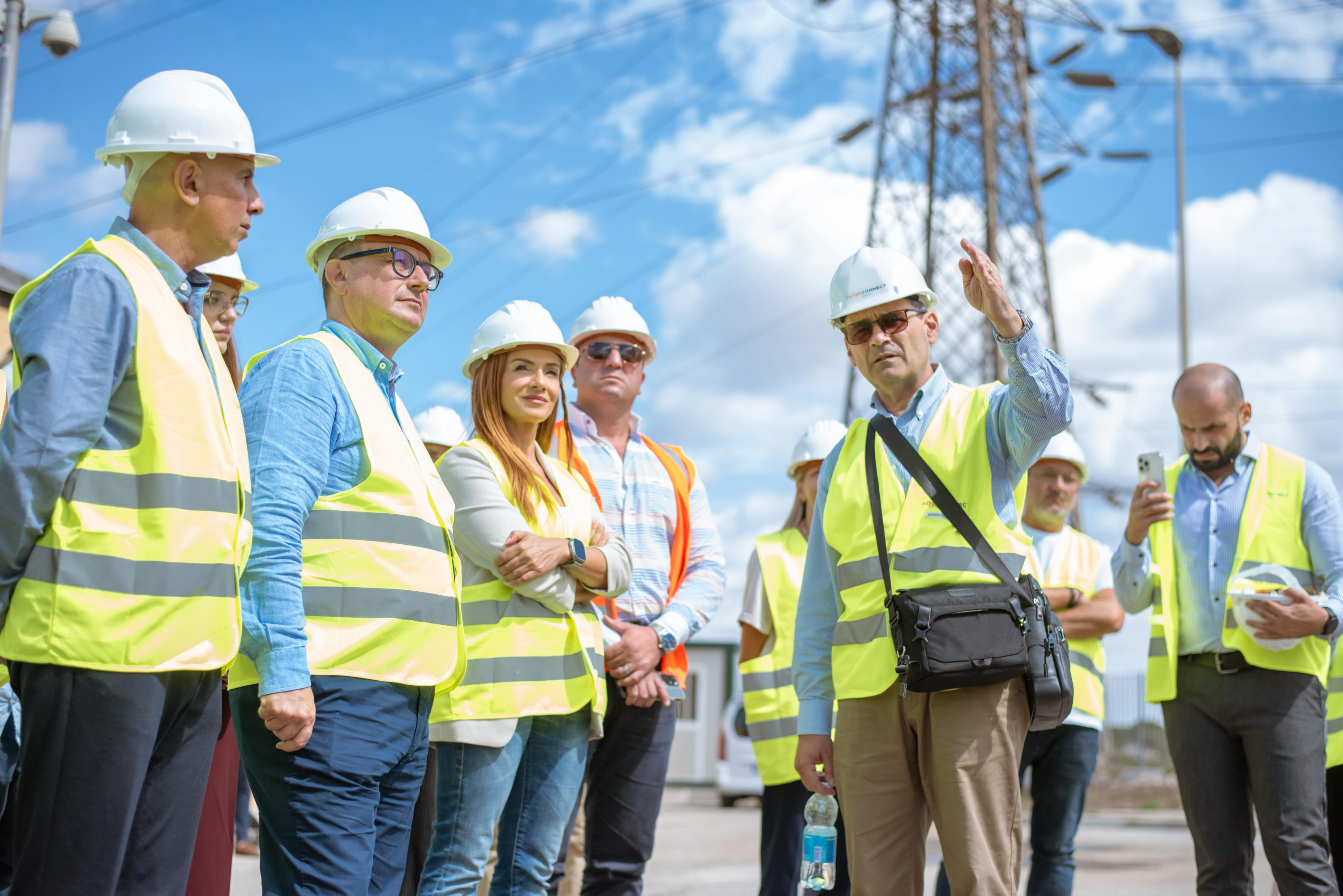
Ministers Miriam Dalli (third from left) and Stefan Zrinzo Azzopardi (second from left) visited trenching works in Ragusa in preparation for the laying of the second interconnector between Sicily and Malta

Malta’s second electricity interconnector with Sicily has reached a significant milestone, with 65% of the land cable manufacturing now complete.
The interconnector will link Ragusa in southern Sicily with Magħtab on Malta’s eastern coast and involves the laying of 21km of land cable and 99km of subsea cable.
“This interconnector represents our commitment to making Malta’s energy sector more resilient and sustainable, thereby strengthening Malta’s energy mix,” Energy Minister Miriam Dalli said during a tour of the works underway in Sicily.

The Ragusa electricity station from where Malta gets its imported electricity from
The 122-kilometre, 225 megawatts high-voltage AC cable project is managed by government-owned Interconnect Malta and is expected to be completed by the end of next year.
The cable’s capacity represents nearly one-third of Malta’s peak summer electricity demand, according to Interconnect Malta CEO Ismail D’Amato, an engineer.
Co-financed by the 2021-2027 European Regional Development Fund, the project will double Malta’s electricity interconnection capacity with the European grid. Italian partners SELT have completed 15% of land-based work in Sicily, whilst Nexans is manufacturing the marine cable in Charleston, USA
“The second interconnector forms a central part of our long-term energy strategy, designed to support a cleaner energy future. The project will enhance integration of locally sourced renewable energy, including the floating offshore wind project, driving forward Malta’s decarbonisation goals,” Dalli said.
The submarine cable will be installed up to 175 metres below sea level, with the cable containing three cores and 36 fibre optic strands. Advanced horizontal direction drilling technology will be used to transition from sea to land, and upon completion, the cable will be completely underground, rendering it invisible from the surface.
According to the project’s cost-benefit analysis, 13.5 million tonnes of CO2 emissions will be reduced, enhancing its significance in Malta’s decarbonisation strategy. The project will deliver €712 million in economic benefits over its lifetime.

Trenching works to lay the second interconnector to Malta are underway in Sicily
The second interconnector contributes to Malta’s broader national energy strategy, which includes a 300MW offshore wind farm project and battery energy storage systems, both essential to enable the shift toward cleaner energy.
European Funds Minister Stefan Zrinzo Azzopardi said the second interconnector is Malta’s largest ERDF-funded operation.
“This interconnector is not just about infrastructure. It is about guaranteeing a secure, resilient, and sustainable energy future for our people. Together with our European partners, we are turning this vision into reality,” Zrinzo Azzopardi said.
However, Malta will face temporary disconnection from the European grid next year when the first interconnector is switched off for up to 20 days to allow essential construction work. Interconnect Malta Division Manager Joseph Vassallo, an engineer, said the shutdown is needed to connect new hybrid switchgear.
“The second interconnector is a massive undertaking, built on state-of-the-art technology, which will play a key role in Malta’s transition to cleaner energy, bringing us closer to our national climate objectives and achieving a carbon-neutral economy by 2050,” Interconnect Chairman Godwin Agius said.
The second interconnector follows a different route from Malta’s first interconnector completed in 2015. The first interconnector ended Malta’s isolation from the European energy network with a 200MW capacity link between Baħar iċ-Ċagħaq and Marina di Ragusa.

Juliana Zammit is a part-time staff reporter and social media journalist.
She is current...